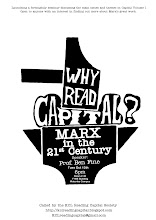
Thanks to everyone who participated in the Reading Group this year. We will be returning at the beginning of next term with a special event. We are also hoping to formally become part of KCLSU and start up a lending library as part of the group with various texts of interest, as well as copies of Capital for members to borrow.
So look out for us at the Welcome Fair, and make sure to join and sign up to the email list for further updates.
Enjoy your summer!
KCL Reading Capital
Saturday, 25 July 2009

Tuesday, 26 May 2009
‘Exploitation & the Working Day’
Lorenzo Fusaro, of the KCL Reading Capital Movement, will introduce a discussion on
‘Exploitation & the Working Day’.
Tuesday 2nd June
6pm
Ground Floor Strand Building Room 1
“Capital is dead labour, that, vampire-like, only lives by sucking living labour, and lives the more, the more labour it sucks.”
“…in the history of capitalist production, the determination of what is a working-day, presents itself as the result of a struggle, a struggle between collective capital, i.e., the class of capitalists, and collective labour, i.e., the working-class”
N.B. We will be reading chapters 9 & 10 in preparation for this discussion.
Wednesday, 13 May 2009
Valorization and the Labour Process
A member of the KCL Reading Capital Movement, will introduce a discussion on
‘Valorization and the Labour Process: Surplus Value, Constant Capital & Variable Capital’.
Tuesday 19th May
6pm
Ground Floor Strand Building Room 1
“That part of capital then, which is represented by the means of production, by the raw material, auxiliary material and the instruments of labour does not, in the process of production, undergo any quantitative alteration of value. I therefore call it the constant part of capital, or, more shortly, constant capital. On the other hand, that part of capital, represented by labour-power, does, in the process of production, undergo an alteration of value. It both reproduces the equivalent of its own value, and also produces an excess, a surplus-value, which may itself vary, may be more or less according to circumstances. This part of capital is continually being transformed from a constant into a variable magnitude. I therefore call it the variable part of capital, or, shortly, variable capital.”
Tuesday, 31 March 2009
‘The Transformation of Money into Capital’
Take Capital home over the holidays, because when we return Biswadip Dasgupta, a member of the KCL Reading Capital Movement, will introduce a discussion on
‘The Transformation of Money into Capital’.
Tuesday 5th May
6pm
Ground Floor Strand Building Room 1
“The consumption of labour-power is completed, as in the case of every other commodity, outside the limits of the market or of the sphere of circulation. Accompanied by Mr. Moneybags and by the possessor of labour-power, we therefore take leave for a time of this noisy sphere, where everything takes place on the surface and in view of all men, and follow them both into the hidden abode of production, on whose threshold there stares us in the face “No admittance except on business.” Here we shall see, not only how capital produces, but how capital is produced. We shall at last force the secret of profit making.”
N.B. We are reading Part II: Chapters 4-6 in preparation for this meeting.
Tuesday, 17 March 2009
‘Money or the Circulation of Commodities’
The reading movement continues to grow with 20 people attending our second session. At the next meeting, John Cooper, of the KCL Reading Capital Movement, will introduce a discussion on:
‘Money or the Circulation of Commodities’.
Tuesday 24th March
6pm
Ground Floor Strand Building Room 1
“It is not money that renders commodities commensurable. Just the contrary. It is because all commodities, as values, are realised human labour, and therefore commensurable, that their values can be measured by one and the same special commodity, and the latter be converted into the common measure of their values, i.e., into money. Money as a measure of value, is the phenomenal form that must of necessity be assumed by that measure of value which is immanent in commodities: labour-time.”
N.B. We are reading Chapter 3 in preparation for this meeting.
In case of doubt the original: “Capital” – an overview of its interpretations
For more than a hundred years introductory and accompanying literature to “Capital” has been produced. For as long as the work itself, the need has existed for comprehensible summaries, because the original text is extremely long and at times difficult to approach. In some places the book raises more questions than it answers and secondary literature can be helpful here. But we should be aware that every text accompanying “Capital” also has its own subjective interpretation and views the text from a certain angle.
The text can be read from a logical as well as from a historical point of view. It can be seen in the perspective of gender politics or interpreted with regard to law, etc. In addition there are many political traditions that each interpret Marx’s work in their own way (see below). This is how a lively debate about the “correct” interpretation of “Capital” has developed. As a beginner one can easily lose track of this jungle of debates and the hundreds of contributions made. And one should be careful not to have read more of the secondary literature than of the actual text. This way one can also avoid the danger of being too quickly taken up by any one particular way of reading “Capital”.
In the Reading Capital group we do not want to insist on one specific version. Since we are starting without preconditions the primary text by Marx is at the centre and should also be the point of reference in discussions.
The following table illustrates very basically the different (historical) schools of interpretation of Marx, or of the different “Marxisms”. The schematic subdivision follows a very rough and simplified pattern. The years are merely to give an approximate orientation – the actual transitions were much more fluid and the blocks represented here are by far not that homogenous. Who wants to have a look at the different “schools” of Marxism can find useful indications in Leszek Kolakowski’s three-volume work “Main Currents of Marxism”. Each of these different perspectives has produced texts accompanying “Capital”, each with specific nuances – which is why there can be no “objective” secondary literature.
What? / When? / Where? / Main focus
Traditional Marxism 1st Generation / from 1878 on / SPD, 2nd International, Engels, Kautsky, Bebel, Bernstein and others / development of history along laws of nature
Traditional Marxism, 2nd Generation / 1914 until early 1920’s / Early 3rd International, Luxemburg, Lenin, Trotsky, Bucharin / Revolutionary perspective, against Reformism of 2nd International
Trad. Communist Interpretation, Marxism-Leninism / after 1928 / Communist Parties after Stalinisation / Party as the centre of praxis and theory, Marxism as state- Doctrine (USSR)
Western Marxism, Reference to working class / from 1923 on / Korsch, Lukács, Gramsci / Subjectivity of revolutionary praxis
Western Marxism, Frankfurt School / from 1930 on / Adorno, Marcuse, Horkheimer / Mechanisms of integration of late Capitalism
Neue Marx-Lektüre / from 1968 on / Backhaus, Heinrich, Hirsch / Critique of forms of capitalist socialisation
The different schools of Marxism stimulate the vivid debates around the interpretation of “Capital”. But the reason for this struggle of interpretation is the work itself. In the following comments we want to exemplify the controversies amongst Marxists by highlighting some points which are the objects of those controversies.
The status of the dialectical method:
In “Capital” Marx does not explicitly state whether and to what extent his analysis uses Hegelian dialectics. How do we therefore have to interpret formulations which seem to follow Hegelian categories (such as form and content or appearance and being)? [FORM, INHALT, SCHEIN, SEIN] And if the dialectic is always implicitly present, how can we understand the work without philosophical knowledge at all?
Historical or logical account in chapter 1 of volume I:
Does the depiction of the development from simple exchange of commodities to the capitalist wage labour (respectively the development of money) follow an imagined, real historical course or does Marx use abstractions in order to identify the specifically capitalist basic forms [GRUNDFORMEN] of value, labour and capital?
There are also differences as to where and when value is developed. An approach which is sometimes referred to as “the substantiveness of value theory” [“werttheoretischer Substantialismus”] situates the creation of value already in production. Others hold the view that value is only created when commodities face each other as commodities, i.e. in the exchange-process.
Another important field of debate is gender relations. To what extent does the analysis of “Capital” consider the oppression of women? What is the relation between wage labour and reproductive labour (Reproduktionsarbeit) in the determination of the value of labour-power?
This is only a small selection of questions and controversies which have emerged from “Capital”. The most important questions, however, often develop in the reading groups themselves and they can be completely different from the ones outlined here. These illustrations do not aim at working along a pre-modelled catalogue of questions, they merely show that reading “Capital” can open up many exciting debates in reading groups.
Tuesday, 3 March 2009
Following an interesting discussion at our first session with 18 people attending, Rob Jackson, of the KCL Reading Capital Movement, will introduce a discussion on
‘The Secret of the Fetishism of Commodities’.
Tuesday 10th March
6pm
Ground Floor Strand Building Room 1
“A commodity is therefore a mysterious thing, simply because in it the social character of men’s labour appears to them as an objective character stamped upon the product of that labour; because the relation of the producers to the sum total of their own labour is presented to them as a social relation, existing not between themselves, but between the products of their labour."
N.B. We are reading section 4 of Chapter 1 in preparation for this meeting.
Subscribe to:
Posts (Atom)