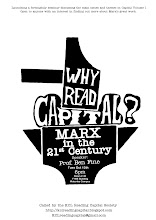
1) Welcome back - All welcome:
Here's hoping that everyone had a relaxing holiday and perhaps found some time to read! Please feel free to come along to any of our meetings this term, whether you want to join the reading groups themselves (Are you thinking about reading Capital? Have a look at the links below), or come to one of the meetings organised by the Contemporary Marxist Theory Seminar (Full timetable available at http://www.kclreadingcapital.blogspot.com)
Wage Labour and Capital:
http://www.marxists.org/archive/marx/works/1847/wage-labour/index.htm
Capital Volume I:
http://www.marxists.org/archive/marx/works/1867-c1/
Capital Volume II:
http://www.marxists.org/archive/marx/works/1885-c2/index.htm
- - -
2) Volume II Group: 'Theories of Fixed and Circulating Capital - Ricardo' & 'The Working Period, Time of Production and Time of Circulation'
The recording of the discussion from our last meeting on 'Theories of Fixed and Circulating Capital - Smith and the Physiocrats' is available here: http://rapidshare.com/files/438786805/KCLReadingCapital_20_Dec_2010.mp3.
Our next session will be discussing Vol.II chapters 11-14 on 'Theories of Fixed and Circulating Capital - Ricardo' & 'The Working Period, Time of Production and Time of Circulation':
Monday 17th January
6pm
Ground Floor Room 3
Strand Building
King's College London
"It is evident at the outset that the definition of capital invested in labour-power as circulating or fluent capital is a secondary one, obliterating its differentia specifica in the process of production. For in this definition, on the one hand, the capitals invested in labour are of the same importance as those invested in raw material, etc. A classification which identifies a part of the constant capital with the variable capital does not deal with the differentia specifica of variable capital in opposition to constant capital."
- - -
3) Volume I Group: 'Exchange and Money, or the Circulation of Commodities'
The discussion from the previous session on 'The Fetishism of Commodities' is available to download here:
http://rapidshare.com/files/434577032/KCLReadingCapital_01_Dec_2010.mp3
The Volume I reading group will return on Wed 26th Jan 6:30pm, Room S3.32, with a discussion on 'Exchange and Money, or the Circulation of Commodities':
Wednesday 26th January
6:30pm
Room S3.32
Strand Building
King's College London
"All commodities are non-use-values for their owners, and use-values for their non-owners. Consequently, they must all change hands. But this change of hands is what constitutes their exchange, and the latter puts them in relation with each other as values, and realises them as values. Hence commodities must be realised as values before they can be realised as use-values."
N.B. We will be reading Vol.I chapters 2-3 for this session.
- - -
4) LONDON SEMINAR ON CONTEMPORARY MARXIST THEORY
"In Search of the Young Marx's Politics"
- David Leopold (University of Oxford)
- Stathis Kouvelakis (King's College, London)
19th January, 5pm
King's College London, Strand Campus, S2.28
For further information, please contact:
Alex Callinicos: alex.callinicos [at] kcl.ac.uk
Stathis Kouvelakis: stathis.kouvelakis [at] kcl.ac.uk
Costas Lapavitsas: cl5 [at] soas.ac.uk
Peter Thomas: PeterD.Thomas [at] brunel.ac.uk
- - -
5) Internation Socialism Journal 129 out now:
- A quarterly journal of socialist theory -
Analysis
The student revolt and the crisis
Mad as hatters? The Tea Party movement in the US
Megan Trudell
Police killings and the law
Simon Behrman
Labourism and socialism: Ralph Miliband’s Marxism
Paul Blackledge
...and more.
http://www.isj.org.uk/
Friday, 7 January 2011

LONDON SEMINAR ON CONTEMPORARY MARXIST THEORY
In Search of the Young Marx's Politics
19th January, 5pm
King's College London, Strand Campus, S2.28
David Leopold (University of Oxford)
Stathis Kouvelakis (King's College, London)
The global economic and financial crisis has witnessed a deepening of
interest in different forms of critical and radical thought and
practice. This seminar will explore the new perspectives that have
been opened up by interventions of contemporary Marxist theory in this
political and theoretical conjuncture. It involves collaboration among
Marxist scholars based in several London universities, including
Brunel University, King’s College London, and the School of Oriental
and African Studies. Guest speakers – from both Britain and abroad –
will include a wide range of thinkers engaging with many different
elements of the various Marxist traditions, as well as with diverse
problems and topics. The aim of the seminar is to promote fruitful
debate and to contribute to the development of more robust Marxist
analysis. It is open to all.
2010/11 Seminar Series
9th February, 5pm
King's College London, Strand Campus, S2.28
Alberto Toscano (Goldsmiths, University of London)
Marxism: A Realism of the Abstract?
23rd March, 5pm
King's College London, Strand Campus, room TBA
Esther Leslie (Birkbeck College)
Flat Screens and Liquid Crystals: On the Politics of Aesthetics and
Vice Versa
18th May, 5pm
King's College London, Strand Campus, K.3.11 Raked Lecture Theatre
Gail Day (University of Leeds)
Dialectical Passions: Art Theory, Art History and Marxism
Additional seminars in Spring 2011 will be announced in due course.
For further information, please contact:
Alex Callinicos, European Studies, King's: alex.callinicos [at]
kcl.ac.uk
Stathis Kouvelakis, European Studies, King's: stathis.kouvelakis [at]
kcl.ac.uk
Costas Lapavitsas, Economics, SOAS: cl5 [at] soas.ac.uk
Peter Thomas, Politics and History, Brunel: PeterD.Thomas [at]
brunel.ac.uk
Thursday, 16 December 2010
Last session before Holidays
1) Vol.II - Last Session before hols: 'Theories of Fixed and Circulating Capital - Smith and the Physiocrats'
Unfortunately we did not record the discussion from our last meeting on 'Turnover and Time & Fixed and Circulating Capital'.
Our next session will be discussing Vol.II chapters 9-10 on 'Theories of Fixed and Circulating Capital - Smith and the Physiocrats':
Monday 20th December
6pm
Room S-3.18
Strand Building
King's College London
"By thus establishing the definition of circulating capital as being the determinant of the capital value laid out for labour-power — this physiocratic definition without the premise of the physiocrats — Adam Smith fortunately killed among his followers the understanding that that part of capital which is spent on labour-power is variable capital. The more profound and correct ideas developed by him elsewhere did not prevail, but this blunder of his did."
The first Vol.II reading group after the hols will be Mon 17th Jan 6pm, Room tbc.
- - -
2) Vol.I - Returning after hols: 'Exchange and Money, or the Circulation of Commodities'
The Volume I reading group will return after the holidays on Wed 12th Jan 6:30pm, Room tbc, with a discussion on 'Exchange and Money, or the Circulation of Commodities':
"All commodities are non-use-values for their owners, and use-values for their non-owners. Consequently, they must all change hands. But this change of hands is what constitutes their exchange, and the latter puts them in relation with each other as values, and realises them as values. Hence commodities must be realised as values before they can be realised as use-values."
We will be reading Vol.I chapters 2-3. The discussion from the previous session on 'The Fetishism of Commodities' is available to download here:
http://rapidshare.com/files/434577032/KCLReadingCapital_01_Dec_2010.mp3
- - -
Sunday, 28 November 2010
'The Fetishism of Commodities' & 'Turnover Time & Fixed and Circulating Capital'
1) Vol. I - Next Session: 'The Fetishism of Commodities'
The Volume I group continues this week (note later start time) with a discussion on 'The Fetishism of Commodities', introduced by Socialist Review Books Editor, Jack Farmer:
Wednesday 1st December
*** 7.30pm ***
Room S-1.08
Strand Building
King's College London
"A commodity is therefore a mysterious thing, simply because in it the social character of men’s labour appears to them as an objective character stamped upon the product of that labour; because the relation of the producers to the sum total of their own labour is presented to them as a social relation, existing not between themselves, but between the products of their labour..."
"...This I call the Fetishism which attaches itself to the products of labour, so soon as they are produced as commodities, and which is therefore inseparable from the production of commodities."
N.B. We will be reading Vol.I, Chapter 1, Section 4 for this meeting.
Facebook event at: http://www.facebook.com/event.php?eid=112044228861591
(The first meeting on 'Commodities and Values' can be downloaded here:http://rapidshare.com/files/430908198/KCLReadingCapital_RobJacksonVolI_November_10_2010.mp3)
- - -
2) Vol.II - Next Session: 'Turnover Time & Fixed and Circulating Capital'
The discussion from our last meeting on 'Times & Costs of Circulation' is available here: http://rapidshare.com/files/432540457/KCLReadingCapital_22_Nov_2010.mp3
Our next session will be discussing chapters 7-8 on 'Turnover Time & Fixed and Circulating Capital':
Monday 6th December
6pm
Room S-3.18
Strand Building
King's College London
"From the point of view of the capitalist, the time of turnover of his capital is the time for which he must advance his capital in order to create surplus-value with it and receive it back in its original shape."
"[The] portion of the capital-value fixed in the instrument of labour circulates as well as any other. We have seen in general that all capital-value is constantly in circulation, and that in this sense all capital is circulating capital. But the circulation of the portion of capital which we are now studying is peculiar. In the first place it does not circulate in its use-form, but it is merely its value that circulates, and this takes place gradually, piecemeal, in proportion as it passes from it to the product, which circulates as a commodity. During the entire period of its functioning, a part of its value always remain fixed in it, independently of the commodities which it helps to produce. It is this peculiarity which gives to this portion of constant capital the form of fixed capital. All the other material parts of capital advanced in the process of production form by way of contrast the circulating, or fluid, capital."
N.B. We will be reading Vol.II Chapters 7-8 for this meeting.
Facebook event at: http://www.facebook.com/event.php?eid=173865585976269
- - -
3) Upcoming Events:
London Seminar on Contemporary Marxist Theory:
15th December, 5pm King's College London, Strand Campus, K.3.11 Raked Lecture Theatre
Peter D. Thomas (Brunel University) Contours of Contemporary Western Marxism
Sunday, 14 November 2010
Next sessions & previous recordings
1) Vol. I - Next Session: 'The Fetishism of Commodities'
The Volume I group began last week with a discussion on 'Commodities and Values', (which can be downloaded here: http://rapidshare.com/files/430908198/KCLReadingCapital_RobJacksonVolI_November_10_2010.mp3).
Our sessions on Volume I will be every 3 weeks. The next (1st Dec) will be a discussion on 'The Fetishism of Commodities', introduced by former KCL student, Jack Farmer:
Wednesday 1st December
6.30pm
Room tbc
Strand Building
King's College London
'A commodity is therefore a mysterious thing, simply because in it the social character of men’s labour appears to them as an objective character stamped upon the product of that labour; because the relation of the producers to the sum total of their own labour is presented to them as a social relation, existing not between themselves, but between the products of their labour...'
'...This I call the Fetishism which attaches itself to the products of labour, so soon as they are produced as commodities, and which is therefore inseparable from the production of commodities.'
N.B. We will be reading Vol.I, Chapter 1, Section 4 for this meeting.
Facebook event at: http://www.facebook.com/event.php?eid=112044228861591
- -
2) Vol.II - Next Session: 'Time & Costs of Circulation'
The introduction and discussion from our last meeting on 'Circuits of Capital' is available here: http://rapidshare.com/files/429870086/KCLReadingCapital_JonnyJones_November_8_2010.mp3.
As the material was quite lengthy we will be doing a further session discussing chapters 1-4 as well as reading and discussing the 'Time & Costs of Circulation':
Monday 22nd November
6pm
Room S-3.18
Strand Building
King's College London
"We have seen that the movement of capital through the sphere of production and the two phases of the sphere of circulation takes place in a series of periods of time. The duration of its sojourn in the sphere of production is its time of production, that of its stay in the sphere of circulation its time of circulation. The total time during which it describes its circuit is therefore equal to the sum of its time of production and its time of circulation."
N.B. We will be re-capping Vol.II, Chapters 1-4, and reading Chapters 5-6 for this meeting.
Facebook event at: http://www.facebook.com/event.php?eid=117738471623262
Tuesday, 9 November 2010
Volume I Group begins:
Have you been thinking, 'Well, Volume II sounds very interesting, but I haven't read Volume I yet'? Now is your chance to do something about it. The Capital Volume I reading group begins next week with a discussion on 'Commodities and Values', (assuming London's Universities haven't been shut down by the UCU/NUS demo earlier that day! - http://www.demo2010.org/)
Wednesday 10th November
6.30pm
Room S-1.08
Strand Building
King's College London
'The wealth of those societies in which the capitalist mode of production prevails, presents itself as “an immense accumulation of commodities,” its unit being a single commodity. Our investigation must therefore begin with the analysis of a commodity'
N.B. We will be reading Vol.I, Chapter 1, Sections 1-3 for this meeting.
Facebook event at: http://www.facebook.com/event.php?eid=126093377447424
Wednesday, 27 October 2010
Next Session: 'Circuits of Capital'
1) Vol.II - Next Session: 'Circuits of Capital'
The Reading Group had a very interesting discussion last Monday on Ernest Mandel's Introduction to Volume II, which can be downloaded here:
http://rapidshare.com/files/427153667/KCLReadingCapital_NickBeech_October_25_2010.mp3
For our next session, Jonny Jones, deputy-editor of International Socialism Journal, will be presenting a short introduction on 'Circuits of Capital', followed by a discussion. Room details now below:
Monday 8th November
6pm
Room S-3.18
Strand Building
King's College London
"The two forms assumed by capital-value at the various stages of its circulation are those of money-capital and commodity-capital. The form pertaining to the stage of production is that of productive capital. The capital which assumes these forms in the course of its total circuit and then discards them and in each of them performs the function corresponding to the particular form, is industrial capital, industrial here in the sense it comprises every branch of industry run on a capitalist basis."
"Money-capital, commodity-capital and productive capital, do not therefore designate independent kinds of capital whose functions form the content of likewise independent branches of industry separated from one another. They denote here only special functional forms of industrial capital, which assumes all three of them one after the other."
N.B. We will be reading Chapters 1-4 for this meeting.
Facebook event at: http://www.facebook.com/event.php?eid=119774294751013
- - -
2) Upcoming Events & Information:
a) 'Crisis and Critique': Historical Materialism Annual London Conference 2010:
HM London 2010 aims to serve as a forum for dialogue,
interaction and debate between different strands of critical-Marxist theory.
Central London, Thu 11th-Sun 14th November
Registration and Provisional Programme Now Available online: http://www.historicalmaterialism.org/conferences/annual7
b) London Seminar on Contemporary Marxist Theory:
This seminar will explore the new perspectives that have been opened up Marxist theory. It involves collaboration among Marxist scholars based in several London universities. Guest speakers from both Britain and abroad will include a wide range of thinkers engaging with many different elements of the various Marxist traditions, as well as with diverse problems and topics. The aim of the
seminar is to promote fruitful debate and to contribute to the development of more robust Marxist analysis. It is open to all.
9th November, 5pm King's College London, Strand Campus, S-1.04, Raked Lecture Theatre
Massimiliano Tomba (University of Padua) The Historical Materialist at work: Re-reading 'The Eighteenth Brumaire'
15th December, 5pm King's College London, Strand Campus, K.3.11 Raked Lecture Theatre
Peter D. Thomas (Brunel University) Contours of Contemporary Western Marxism
For further information, please contact:
Alex Callinicos, European Studies, King's:
alex.callinicos@kcl.ac.uk
Stathis Kouvelakis, European Studies, King's:
stathis.kouvelakis@kcl.ac.uk
Costas Lapavitsas, Economics, SOAS:
cl5@soas.ac.uk
Peter Thomas, Politics and History, Brunel:
PeterD.Thomas@brunel.ac.uk
c) Education Activist Network Conference:
The EAN conference is an opportunity for students and education workers to discuss how to defeat the cuts in higher, further and adult education and fight for another vision of education.
Among the highlights will be workshops with strikers and student occupiers and a forum on the resistance in Europe with activists from France and Greece. This is a chance to organise for French-style resistance in Britain. Visit the link below to register online.
Education Activist Network National Conference
Sunday 31st October 11am-5pm
King’s College London & London School of Economics
Supported by NUS, London Region UCU and others
http://educationactivistnetwork.wordpress.com/national-conference-31st-october/
d) International Socialism 128 Out Now:
In this issue...
Palestine and Israel
Jamie Allinson analyses Hamas, the Islamist movement that has emerged as the pivotal force in the Palestinians’ struggle for national liberation.
Crisis and resistance
Panos Garganas in Greece speaks from the front line of the struggle there, Christakis Georgiou looks at the crisis in the eurozone and Jane Hardy surveys the forms taken by the Great Recession in Central and Eastern Europe. Also...
Jairus Banaji, on insurgency in rural India, Neil Davidson on struggles in the global South & Trotsky’s theory of permanent revolution, John Molyneux on Marxism & Michelangelo. Simon Pirani defends his interpretation of the aftermath of the Russian Revolution, Jess Edwards differs with the view of sex work put forward by Gareth Dale and Xanthe Whittaker in our last issue.
To order copies, email isj@swp.org.uk, call 020 7819 1177 or send £5.50 to ISJ, PO Box 42184, London SW8 2WD
www.isj.org.uk
- - -
3) Volume I & Highlights:
More information coming soon on the Volume I discussion group.
Subscribe to:
Posts (Atom)