Bis Dasgupta, of the KCL Reading Capital Movement, will introduce a discussion on
'The Fetishism of the Commodity and its secret'
Tuesday 10th November
6pm
F-WB Room 2.43 Waterloo Campus KCL
"Economists have a singular method of procedure. There are only two kinds of institutions for them, artificial and natural. The institutions of feudalism are artificial institutions, those of capitalism are natural institutions. In this they resemble the theologians, who likewise establish two kinds of religion. Every religion which is not theirs is an invention of men, while their own is an emanation from God... Thus there has been history, but there is no longer any."
Thursday, 5 November 2009

Friday, 30 October 2009
The Future of Capitalism: Debate
A Public Debate Hosted by KCL Capital Reading Group and KCL Business Society
Supported by the Centre for European Studies, King's College London
THE FUTURE OF CAPITALISM:
THE ROOTS OF THE CURRENT ECONOMIC CRISIS AND THE PROSPECTS FOR THE SYSTEM AS A WHOLE
ALEX CALLINICOS, Professor of European Studies, King's College London, and author of The Revolutionary Ideas of Karl Marx
MARTIN WOLF, Chief Economics Commentator, Financial Times, and author of Fixing Global Finance
6.30 P.M. MONDAY 2 NOVEMBER
GREAT HALL, KING'S COLLEGE LONDON, STRAND, LONDON WC2R 2LS (PLUS OVERFLOW IN EDMOND J. SAFRA LECTURE THEATRE)
for more information contact KCLreadingCapital@gmail.com
Supported by the Centre for European Studies, King's College London
THE FUTURE OF CAPITALISM:
THE ROOTS OF THE CURRENT ECONOMIC CRISIS AND THE PROSPECTS FOR THE SYSTEM AS A WHOLE
ALEX CALLINICOS, Professor of European Studies, King's College London, and author of The Revolutionary Ideas of Karl Marx
MARTIN WOLF, Chief Economics Commentator, Financial Times, and author of Fixing Global Finance
6.30 P.M. MONDAY 2 NOVEMBER
GREAT HALL, KING'S COLLEGE LONDON, STRAND, LONDON WC2R 2LS (PLUS OVERFLOW IN EDMOND J. SAFRA LECTURE THEATRE)
for more information contact KCLreadingCapital@gmail.com
Friday, 16 October 2009
'Commodities & Values' - Tuesday 27th October 09
Thanks to all who attended our re-launch meeting with Ben Fine (apologies for those who had to sit on the floor and stand by the door!). There is an mp3 of the meeting for download along with older sessions to the right on the blog.
We hope that everyone found the meeting interesting and will consider reading Capital with us. Details of our first meeting are below:
- - -
'Commodities & Values'
The wealth of societies in which the capitalist mode of production prevails appears as an 'immense collection of commodities'.
Marx begins Capital by looking at the elementary building block of capitalism, the commodity.
Marx identifies in the commodity a dual aspect, use-value and exchange value. One gives the commodity its usefulness for the consumer, the other commensurability with other commodities.
- - -
Chris Harman, editor of International Socialism Journal (www.isj.org.uk), introduces a discussion on 'Commodities & Values'
Tuesday 27th October 2009
6pm
Room 2.42 F-WB
Waterloo Campus
King's College London
- - -
-N.B. We will be reading the first 3 sections of Chapter 1 in preparation.
We hope that everyone found the meeting interesting and will consider reading Capital with us. Details of our first meeting are below:
- - -
'Commodities & Values'
The wealth of societies in which the capitalist mode of production prevails appears as an 'immense collection of commodities'.
Marx begins Capital by looking at the elementary building block of capitalism, the commodity.
Marx identifies in the commodity a dual aspect, use-value and exchange value. One gives the commodity its usefulness for the consumer, the other commensurability with other commodities.
- - -
Chris Harman, editor of International Socialism Journal (www.isj.org.uk), introduces a discussion on 'Commodities & Values'
Tuesday 27th October 2009
6pm
Room 2.42 F-WB
Waterloo Campus
King's College London
- - -
-N.B. We will be reading the first 3 sections of Chapter 1 in preparation.
Saturday, 26 September 2009
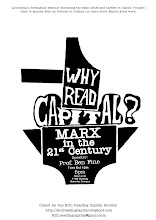
Prof. Ben Fine on 'Why Read Capital?'
The Reading Capital group is re-launching this year with a talk by Prof. Ben Fine from SOAS (co-author of "Marx's 'Capital'") on:
Why read Capital? Marx in the 21st Century
Tuesday Oct. 13th 2009
6pm
Room 2.42
F-WB Building
Waterloo Campus
King's College London
- - -
KCL Reading Capital is a fortnightly seminar organised by students discussing the main issues & themes in Capital Volume I
Open to anyone with an interest in finding out more about Marx's great work.
Why read Capital? Marx in the 21st Century
Tuesday Oct. 13th 2009
6pm
Room 2.42
F-WB Building
Waterloo Campus
King's College London
- - -
KCL Reading Capital is a fortnightly seminar organised by students discussing the main issues & themes in Capital Volume I
Open to anyone with an interest in finding out more about Marx's great work.
Saturday, 25 July 2009
Reading Group Returns in the Autumn
Thanks to everyone who participated in the Reading Group this year. We will be returning at the beginning of next term with a special event. We are also hoping to formally become part of KCLSU and start up a lending library as part of the group with various texts of interest, as well as copies of Capital for members to borrow.
So look out for us at the Welcome Fair, and make sure to join and sign up to the email list for further updates.
Enjoy your summer!
KCL Reading Capital
So look out for us at the Welcome Fair, and make sure to join and sign up to the email list for further updates.
Enjoy your summer!
KCL Reading Capital
Tuesday, 26 May 2009
‘Exploitation & the Working Day’
Lorenzo Fusaro, of the KCL Reading Capital Movement, will introduce a discussion on
‘Exploitation & the Working Day’.
Tuesday 2nd June
6pm
Ground Floor Strand Building Room 1
“Capital is dead labour, that, vampire-like, only lives by sucking living labour, and lives the more, the more labour it sucks.”
“…in the history of capitalist production, the determination of what is a working-day, presents itself as the result of a struggle, a struggle between collective capital, i.e., the class of capitalists, and collective labour, i.e., the working-class”
N.B. We will be reading chapters 9 & 10 in preparation for this discussion.
‘Exploitation & the Working Day’.
Tuesday 2nd June
6pm
Ground Floor Strand Building Room 1
“Capital is dead labour, that, vampire-like, only lives by sucking living labour, and lives the more, the more labour it sucks.”
“…in the history of capitalist production, the determination of what is a working-day, presents itself as the result of a struggle, a struggle between collective capital, i.e., the class of capitalists, and collective labour, i.e., the working-class”
N.B. We will be reading chapters 9 & 10 in preparation for this discussion.
Wednesday, 13 May 2009
Valorization and the Labour Process
A member of the KCL Reading Capital Movement, will introduce a discussion on
‘Valorization and the Labour Process: Surplus Value, Constant Capital & Variable Capital’.
Tuesday 19th May
6pm
Ground Floor Strand Building Room 1
“That part of capital then, which is represented by the means of production, by the raw material, auxiliary material and the instruments of labour does not, in the process of production, undergo any quantitative alteration of value. I therefore call it the constant part of capital, or, more shortly, constant capital. On the other hand, that part of capital, represented by labour-power, does, in the process of production, undergo an alteration of value. It both reproduces the equivalent of its own value, and also produces an excess, a surplus-value, which may itself vary, may be more or less according to circumstances. This part of capital is continually being transformed from a constant into a variable magnitude. I therefore call it the variable part of capital, or, shortly, variable capital.”
‘Valorization and the Labour Process: Surplus Value, Constant Capital & Variable Capital’.
Tuesday 19th May
6pm
Ground Floor Strand Building Room 1
“That part of capital then, which is represented by the means of production, by the raw material, auxiliary material and the instruments of labour does not, in the process of production, undergo any quantitative alteration of value. I therefore call it the constant part of capital, or, more shortly, constant capital. On the other hand, that part of capital, represented by labour-power, does, in the process of production, undergo an alteration of value. It both reproduces the equivalent of its own value, and also produces an excess, a surplus-value, which may itself vary, may be more or less according to circumstances. This part of capital is continually being transformed from a constant into a variable magnitude. I therefore call it the variable part of capital, or, shortly, variable capital.”
Subscribe to:
Posts (Atom)